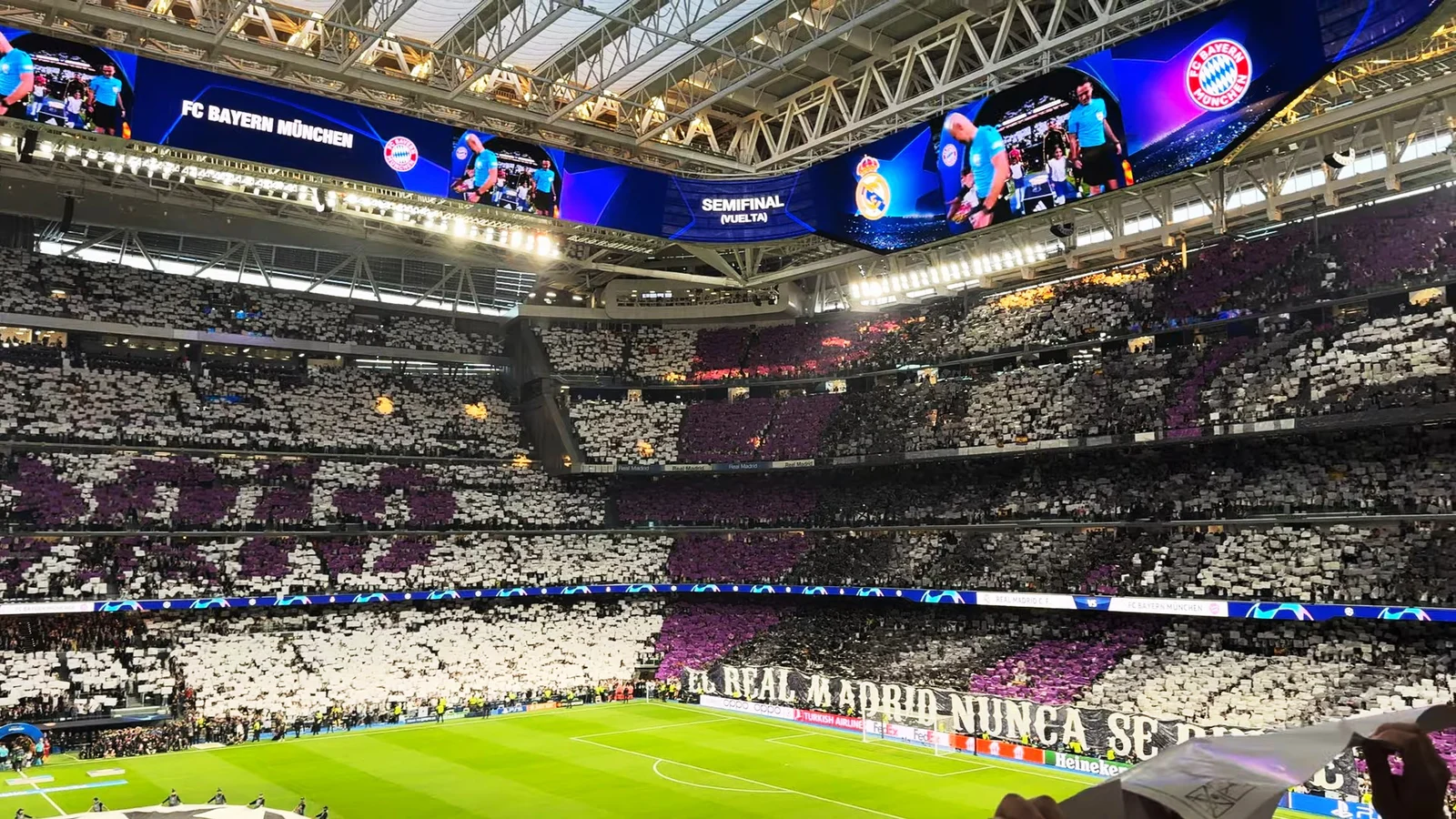
A football club can win the title and still need another cheque from its owner. Ascend Sport Technology makes its money from the work that happens around the match.
It is the same El Clásico in Madrid and Amsterdam. In the Netherlands, though, the advertising around the pitch can tell viewers to order dinner from a delivery app they can use that evening. A Spanish advertiser can buy the equivalent space on another feed. The match is already being played, the cameras are already there and the two advertisers can each buy the audience they can actually serve.
Ascend works with the club to create that extra advertising space and find buyers for it. The club earns more from a match it is already staging. Where Ascend is paid a commission or a share of sales, it earns more as those sales grow too. That partnership can also cover running the stadium screens, producing the live feed and showing sponsors who saw their campaigns.
Ascend plans to take that business public on SIX Swiss Exchange through its proposed merger with EvoNext. At the CHF2.50 midpoint of the proposed placement, the combined company would be valued at CHF540 million. Ascend reported CHF25 million of EBITDA for FY2025/26. We estimate the combined company would have roughly CHF51 million in net liquid funds after an allowance for transaction costs.[1][2]
Growing with existing clients
A club or league can start with match production or stadium signage and add virtual overlay, advertising sales or audience measurement over time. AIM Sport has signed long-term contracts with clubs including Real Madrid, Paris Saint-Germain and AC Milan, according to its investor Lennertz & Co. Those agreements give Ascend work across multiple seasons and room to sell more within relationships it already has. An existing client can buy another service before its original contract comes up for renewal.[3]
That opportunity extends well beyond a handful of clubs. EvoNext says Ascend serves more than 100 rights holders and more than 500 brands and broadcasters across more than 20 countries. Ascend’s growth plan includes doing more work with those clients, signing new ones and entering new markets.[4]
SportsGlare understands that around 85% of AIM Sport’s revenue comes from recurring work supported by long-term agreements. The rest comes from projects such as one-off events, tournaments and individual sponsor campaigns. A season of contracted work gives AIM a base to build on even in a year without a World Cup.
At the Bernabéu, AIM Sport’s work starts before kick-off. SportsGlare understands it supplies Real Madrid’s dressing-room LED displays, the pitchside LED boards and even the plinth that holds the match ball. AIM also provides the software that connects screens across the stadium so the club can manage what plays on each display.
By 2019/20, Real Madrid was using AIM’s overlay technology to vary the adverts on its pitchside boards across broadcasts of home LaLiga and Copa del Rey matches. Madrid brought in IMG to sell the virtual space. By May 2025, Ascend was bringing advertisers to the club’s broadcasts through Adrenali.ne. Venezuela’s Empresas Polar used the platform and AIM’s technology to put Polar Pilsen and Maltín Polar on the boards during Real Madrid’s match against Real Sociedad. Viewers in Venezuela and across Latin America saw the campaign. The same club relationship spans the hardware in the stadium, the software that runs it and the sale of advertising on the broadcast.[5][6]
The same match, a different advert
AIM Sport’s Digital Overlay inserts advertising into the broadcast feed. As the camera moves, the advert stays in place in the picture and disappears behind a player who runs in front of it. A club can use the boards it already owns, regardless of who supplied them, or create a virtual placement in an empty part of the image. That gives a club a way to add new inventory without replacing its stadium equipment.[7][8][9]
| Business | Where it earns revenue |
|---|---|
| AIM Sport | Virtual advertising, production, commercial services and live match operations |
| Abcoya | LED screens and digital signage for stadiums and other venues |
| Adrenali.ne | A marketplace for brands to buy sports advertising in individual markets |
| SPIQE | Fan audience data, sponsorship measurement and advertising attribution |
| Sporttotal Pro | Streaming and video data technology |
Ascend can earn installation and operating fees, software and production fees, advertising commissions or a share of sales, depending on the agreement. A venue that needs physical screens can buy or lease the equipment separately. A brand can buy exposure through Adrenali.ne and measure it through SPIQE.[10][11]
From regional feeds to fan profiles
Ascend brought FanAI into the business through SPIQE’s acquisition of the company in 2024. FanAI linked audience data with purchase data to help sponsors trace exposure through to sales. SPIQE’s audience graph adds a way to build fan profiles, sometimes called Fan IDs, around interests and behaviour. The ambition is to use those profiles to personalise virtual adverts in digital feeds where audience data, broadcast rights and privacy rules permit it. A streaming service could eventually serve different adverts to different groups of viewers in the same market.[12][13]
In the 2026 World Cup knockout matches, AIM Sport used virtual advertising to make the pitchside boards appear taller on television, increasing the amount of space available to the sponsor. That is one way software can create more advertising space from the same broadcast. SportsGlare’s World Cup reporting
Pitchside boards are some of football’s most valuable advertising space. The brand appears in the picture fans tuned in to watch, where it can pick up some of the goodwill people feel towards the club or competition. That association can translate into stronger purchase intent. It comes with the scale of live sport. FIFA puts the combined average US audience for the 2026 World Cup final at 62.8 million across FOX and Telemundo.[14][15][16]
The broadcast footage gives brands a way to check exactly when an advert aired and how long it was on screen. Proof of delivery comes from the footage itself, independent of click counts or digital impressions that bots can inflate. The space still has to be sold. Adrenali.ne makes it easier to buy the feed that reaches the people a brand wants to reach, and SPIQE can help the brand see what it got from the campaign.
Building out the sports operating system
Ascend is a buy-and-build platform. Its businesses cover several jobs that a rights holder has to get done for every match, from producing the feed and creating advertising space to selling it and measuring how it performed. That is the idea behind a sports operating system. FanAI shows how an acquisition can add a step to it. The attribution technology it brought into SPIQE helps brands see whether the audience they paid to reach went on to buy their products.[12]
The merger announcement says Ascend plans to use the cash it generates for organic growth, selective rights purchases and acquisitions that add capabilities, open new markets or increase market share. A specialist can bring technology that Ascend can sell to its existing customers. A business with local rights-holder relationships can help take Ascend’s existing tools into a new league, country or sport. The return on those deals will depend on what Ascend pays and how well the businesses work together.[17]
The World Cup in Ascend’s accounts
Net revenue rose 17% to CHF43.8 million in FY2025/26. EBITDA grew 32% to CHF25 million, taking the margin from about 51% to 57%. Ascend had CHF76 million of shareholders’ equity and CHF33.1 million in cash and securities at the June year-end. Adding the gross primary proceeds at CHF2.50 to historical equity gives CHF96 million before placement costs and merger accounting.[1][18]
| CHF million, except margins | FY2024/25 | FY2025/26 |
|---|---|---|
| Net revenue | 37.3 | 43.8 |
| EBITDA | 18.9 | 25.0 |
| EBITDA margin | 50.7% | 57.1% |
| Cash and cash equivalents | 26.8 | 30.1 |
| Securities | 3.9 | 3.0 |
| Net working capital | 8.9 | 15.1 |
| Financial liabilities | 4.0 | 2.6 |
| Shareholders’ equity | 66.8 | 76.0 |
Ascend reports in Swiss francs and, SportsGlare understands, earns most of its sales in euros and dollars. The franc strengthened against both currencies between the two financial years. Using ECB monthly averages, a euro bought about 1.8% fewer francs in FY2025/26 and a dollar about 8.5% fewer. That would have made foreign sales look smaller in the Swiss accounts and suggests growth was stronger in the currencies customers actually paid. The size of the effect depends on how much Ascend earned in each currency and when.[19]
At group level, Ascend’s operating cash flow rose about 31% in FY2025/26, from CHF10.1 million to CHF13.3 million, while spending on tangible and intangible assets fell from CHF12.4 million to CHF11.7 million.[18]
Ascend closed its financial year in the middle of the World Cup, with CHF15.1 million tied up in net working capital at the end of June, up from CHF8.9 million a year earlier. EvoNext says the gap between when Ascend bills customers and when it pays suppliers around major events temporarily lifts that balance, which then returns to more usual levels after the event.[1]
EvoNext says Ascend expects capital spending to fall from around 27% of net revenue in FY2025/26 to 20–24% in FY2026/27 and towards the mid-teens over time. As Ascend uses equipment it already owns across more work, EvoNext expects the amount spent in francs to stay broadly in line with historical levels even as sales grow.[4]
The placement valuation
Krugman Insights calculated that the agreed CHF500 million equity value for Ascend was about 11.4 times net sales and 20 times EBITDA. To value the combined operating business, start with the CHF540 million implied market capitalisation after the merger. Subtract the liquid assets and the new placement cash, then add financial debt. That gives an enterprise value of about CHF484 million, or 19.4 times FY2025/26 EBITDA before transaction costs.[20]
| Valuation at CHF2.50 per share | CHF million |
|---|---|
| Equity value of 215,999,978 shares | 540.0 |
| Less Ascend cash and securities | (33.1) |
| Less EvoNext cash and liquid securities | (5.5) |
| Less gross proceeds from new shares | (20.0) |
| Add Ascend financial liabilities | 2.6 |
| Enterprise value before costs | 484.0 |
| FY2025/26 EBITDA | 25.0 |
| Enterprise value / EBITDA | 19.4× |
Allow CHF5 million for costs or cash used between the June balance sheets and completion and the implied enterprise value rises to CHF489 million, or 19.6× EBITDA and 11.2× net revenue. About CHF51 million of net liquid funds would sit alongside the operating business after that allowance. The 19.6× figure is the starting point for the comparisons below.
Ascend, Real Madrid and Manchester United
A buyer of a football club usually starts with revenue. The fan base, sponsorships and the stadium can hold their value across many seasons, while a year’s profit can turn on European qualification, the wage bill or a single transfer window. Football Benchmark adjusts its club revenue multiples for profitability, popularity, sporting potential, broadcast rights and stadium ownership. For a club’s operating performance, investors also look at wages as a share of revenue, profit before player trading and cash spent on players and facilities. How investors value football clubs[21]
| Business | Enterprise value | Annual revenue | EBITDA | EBITDA margin | EV/revenue | EV/EBITDA |
|---|---|---|---|---|---|---|
| Real Madrid, FY2024/25 | €7.73bn | €1,184.7m | €208.3m before disposals | 17.6% | 6.5× | 37.1× |
| Manchester United, FY2024/25 | £4.44bn | £666.5m | £182.8m adjusted | 27.4% | 6.7× | 24.3× |
| Ascend at CHF2.50, FY2025/26 | CHF489m | CHF43.8m net | CHF25.0m | 57.1% | 11.2× | 19.6× |
Football Benchmark estimates the club enterprise values as of 1 January 2026. The clubs use different EBITDA definitions, and Ascend’s enterprise value is based on the proposed placement and a cost allowance. Even with those differences, putting both multiples in the table changes the comparison. Ascend costs more per franc of annual sales and less per franc of EBITDA. Real Madrid and United offer the scarcity of a famous club, with its fan base, stadium and media rights. Ascend can sell to both sides of a rivalry and collect a production fee whether either side wins. It still has to renew its contracts, deliver the work and sell the extra advertising.[22][23]
A stake in league rights has a different source of returns. In the Boost LaLiga agreement, CVC committed €1.994 billion and took an 8% stake for 50 years in a vehicle housing the bulk of the league’s activities. The investor’s return depends on the cash flows that right conveys, their growth at each broadcast renewal and the years for which the investor participates. Ascend can grow within a rights cycle. A local feed can become a new sale while the existing rights agreement is still in force, provided the contract allows it and an advertiser wants that audience. The ability to open extra inventory across different competitions is why Ascend is a picks-and-shovels investment in sport.[24]
Catapult, screen makers and the Kinexon sale process
Catapult is the closest listed sports technology comparison. Teams buy its hardware and software and can add more products once they use the first one. The Australian-listed company classed 96% of its half-year revenue as recurring and reported US$16.1 million of management EBITDA on US$81.7 million in revenue. A market-data snapshot on 18 November put it at 21.5× trailing EBITDA, down from 26.2× on 15 November. Applying the 21.5× snapshot to Ascend’s CHF25 million of historical EBITDA gives CHF2.72 per share in our model. Catapult earns most of its revenue through recurring products. Ascend’s cash generation also depends on delivering matches and selling advertising.[25][26]
Chinese LED suppliers Leyard and AOTO are most useful for understanding Abcoya. The market data put Leyard at 22.4× trailing EBITDA and AOTO at 84.1×, on EBITDA margins of about 7.5% and 3.6% respectively. AOTO’s ratio reflects a small earnings base. The more useful comparison is the business mix. Ascend can sell the software, production and advertising around a display, and it can sell those services for a screen it never supplied.[27][28]
Kinexon Sports is a useful private-market reference. People familiar with its sale process discussed an enterprise value of around US$150 million. On expected annual recurring revenue of US$17 million, that is about 8.8× ARR. The business was expected to reach EBITDA break-even, so a multiple of its then-current EBITDA would have little meaning. The 20–30× EBITDA range in SportsGlare’s reporting came from separate conversations about profitable sports technology businesses. It helps explain why 20× and 25× are worth testing for Ascend. SportsGlare’s Kinexon reporting
Sportradar and Genius Sports also sell to leagues and broadcasters. Their reliance on betting-data rights, licensed operators and regulation makes a direct valuation comparison harder. Ascend earns revenue across several parts of the live-sport business. A rights holder can pay for stadium equipment or match production, a broadcaster can buy streaming technology, and a brand can buy advertising and measure its impact.[29][30]
The Swiss-listed growth companies
The broader Swiss market offers a better test of the premium than listing precedents alone. We looked across sectors for companies that combine growth with substantial operating margins, then compared their trailing EBITDA against the prices on 18 November. Ypsomed’s injection-systems business comes closest on the two financial measures. Belimo and Galderma show what buyers pay for growth in established, internationally scaled businesses.[31]
| Company | Most recent reported sales growth | Trailing EBITDA margin | EV/trailing EBITDA |
|---|---|---|---|
| Ascend, sports advertising technology | 17.4% in FY2025/26 | 57.1% | 19.6× at CHF2.50 |
| Ypsomed, Delivery Systems | 17.5% in H1 FY2026/27 | About 51.2%, core business | 19.7× on core EBITDA |
| Belimo, building controls | 20.5% in H1 2026 | 24.2% | 30.5× |
| Galderma, dermatology | 28.0% in H1 2026 | 24.7% core | About 37× |
The useful comparison is Ypsomed. It grew its core business at roughly the same rate as Ascend, on a trailing EBITDA margin above 50%, and traded close to 20×. Ypsomed has a larger business and pharmaceuticals project commitments. Ascend is earlier in its expansion and has contracts spread across sports rights holders. Belimo and Galderma show how much higher a multiple can go once growth is established at scale. The sample gives a reason to use 20× as an anchor and to test a premium if Ascend builds a record of growing outside the major tournament years.[32][33][34]
Going into the next tournament cycle
Ascend expects around 10% net revenue growth in FY2026/27, with less revenue coming from international tournaments. To get there, the rest of the business has to make up for the fall in tournament sales and still lift overall revenue by about a tenth. Ascend expects EBITDA to stay close to CHF25 million as it moves past the World Cup and takes on the additional costs of operating as a listed company. A quieter tournament calendar may also help cash flow as the timing of customer and supplier payments returns to normal.[35][1]
At 20×, the CHF2.50 placement midpoint implies about CHF24.5 million of annual EBITDA, a level Ascend reached in FY2025/26. A rise to CHF30 million of EBITDA would put the share at CHF3.01 at the same multiple, using the proposed share count and CHF51 million of net liquid funds. Startupnews.ch flagged both the quieter calendar and the volume of shares existing holders intend to sell.[36]
The four-year ambition is to double net revenue, from CHF43.8 million to about CHF87.6 million, while earning an EBITDA margin of around 50%. That would take annual EBITDA to roughly CHF43.8 million. Revenue would have to grow about 19% a year over the cycle. The 17% reported in the latest year gives a sense of the pace Ascend would need to keep up. Delivering overlay and measurement to more customers, charging for more of the work done for customers already under contract, and adding markets would all help get there.[35]
| Exit EV/EBITDA on CHF43.8m of EBITDA | Year-four value per share | Today at 8% | Today at 10% | Today at 12% |
|---|---|---|---|---|
| 20× | CHF4.29 | CHF3.15 | CHF2.93 | CHF2.73 |
| 23× | CHF4.90 | CHF3.60 | CHF3.35 | CHF3.11 |
| 25× | CHF5.31 | CHF3.90 | CHF3.62 | CHF3.37 |
Scenario values, not price targets. Year-four EBITDA CHF43.8m; net liquid funds CHF51m; 215,999,978 shares. Discounted columns use four years at the stated annual rate. Darker cells indicate higher present values.
With Swiss ten-year government yields around 0.6% on 18 November, an 8% annual required return is a reasonable scenario to put alongside 10% and 12%. All three are modelling assumptions. The share carries risks that a government bond does not, including the pace of contract wins, the cost of rights and technology, and the price at which investors will value a smaller listed business. The model holds net liquid funds at CHF51 million and leaves out interim dividends, cash accumulation, acquisitions and tax savings.[37]
If Ascend delivers its four-year ambition and earns a 20× EBITDA valuation, the model puts the share at CHF4.29 in year four, equivalent to CHF3.15 today at an 8% discount rate. The modelled gain from the CHF2.50 placement reference to CHF4.29 is about 14.5% a year. No separate value is assigned to future deals.
The full ambition is one way to get a return. At the same 20× multiple, CHF35 million of year-four EBITDA gives CHF3.48 per share, or 8.6% a year from CHF2.50. CHF30 million gives CHF3.01, or 4.8% a year. To earn 10% a year, the business would need about CHF37 million of EBITDA in year four. That gives investors a figure to track as Ascend grows beyond the World Cup year.
The merger and placement
EvoNext is what remains of the Swiss biotechnology company Evolva after it sold its operating business. It still has a SIX listing and a balance sheet. Under the proposed merger, EvoNext would issue shares to Ascend’s owners, who would hold most of the combined company before the placement. EvoNext survives as the legal entity, takes the Ascend Sport Technology AG name and keeps its SIX listing. That is why the deal is called a reverse takeover, or RTO. The private company’s business and shareholders take over the listed company even though the listed company is the legal acquirer.[38][35]
The October agreement put Ascend’s equity value at CHF500 million and used CHF2.50 per EvoNext share. That was the low end of the CHF500 million–CHF600 million range Bloomberg reported when the talks surfaced in August. The November announcement set an indicative placement range of CHF2.25–CHF2.75. The merger and placement would leave about 216 million shares outstanding.[39][2]
| Proposed share capital | Shares |
|---|---|
| Existing EvoNext shares | 7,230,626 |
| Shares issued to Ascend shareholders in the merger | 199,999,978 |
| New shares sold in the placement | 8,000,000 |
| Equity participation shares | 769,374 |
| Total | 215,999,978 |
The placement would sell 80 million shares initially. Eight million are new shares, raising CHF20 million gross for the company at CHF2.50. The other 72 million are existing shares, bringing in CHF180 million for selling shareholders. An option to sell a further eight million existing shares, known as the greenshoe, would take the total placement to CHF220 million at that price. It leaves the share count unchanged. The aim is a free float of around 40%, meaning roughly two-fifths of the shares would be available for public trading.[1][2]
UBS leads the placement as sole global coordinator and joint bookrunner, with Zürcher Kantonalbank (ZKB) as the other joint bookrunner. Commerzbank is co-manager in cooperation with ODDO BHF, and Octavian is selling agent. EvoNext currently trades as EVE. The intended symbol for the combined company is SPORT, which would appear as SPORT.SW on quote services using the Swiss suffix.[2][40]
Blackstone and the private-equity alternative
Mergermarket reported in March 2025 that Ascend had reopened its investor search after receiving interest following Euro 2024. It named Blackstone among the interested parties and reported that its sources expected a valuation above €750 million if a deal went through.[41]
The EvoNext agreement values Ascend’s equity at CHF500 million. The listing would let existing shareholders sell part of their holdings while leaving the founders invested. SportsGlare understands they would retain roughly 40% between them after the placement, making them the largest shareholder bloc. The stake could give them de facto control at shareholder meetings. The listing also gives Ascend access to public capital for expansion and acquisitions.[38]
EvoNext’s CHF317 million of tax losses
EvoNext brings the SIX listing, about CHF5.5 million in cash and liquid securities at June 2026, and a pool of past losses that could reduce the merged company’s future tax bills. Its 2025 annual report recorded CHF317.4 million of tax loss carryforwards. Basel-Landschaft and Lucerne have confirmed in principle that EvoNext’s existing losses can remain available after the merger for cantonal and federal direct tax. The surviving listed company, renamed Ascend Sport Technology, can use available losses to offset eligible taxable profits at the Swiss holding-company level, subject to statutory limits. The federal authority’s separate positive feedback concerned withholding tax and stamp duty on the merger.[42][1]
EvoNext’s 2025 annual report estimated CHF37.8 million in potential deferred tax assets from unrecognised losses and deductible temporary differences. Its expiry schedule showed CHF66.7 million of losses due to expire within a year of the 2025 year-end. If that portion expires unused, the remaining losses in the schedule come to about CHF250.7 million. At Lucerne’s 2026 benchmark corporate tax rate of 11.66%, using that entire balance would save roughly CHF29 million before discounting.[42][43]
That is about CHF0.14 per share before discounting, using the proposed share count. The cash saved will depend on how much eligible profit Ascend earns at the Swiss holding-company level before the losses expire. The valuation above treats any tax savings as additional upside.
A board for the next markets
Ascend’s two co-founders would sit alongside five independent directors on the proposed board. The nominations put US sports rights, acquisition finance, advertising sales and Swiss public markets experience around the same table. That combination offers a clue to where Ascend could take the business after the listing. Shareholders are due to vote on the seven nominees on 3 December.[44]
Kathy Carter, US growth and the LA28 opportunity
Kathy Carter ran Major League Soccer’s commercial arm, Soccer United Marketing, before joining LA28. She led the organising committee’s commercial work, including its partnership with NBCUniversal, and later became chief executive. Both jobs involved getting sports properties, broadcasters and advertisers to agree on what sponsors could buy and how those rights would be delivered. That experience fits Ascend’s stated priority of growing in the Americas. It could help the company sell more to US leagues and rights holders as it looks beyond its European football base.[45]
Los Angeles 2028 is the obvious event to watch. Ascend used Digital Overlay at the 2026 World Cup to change the appearance of pitchside boards in the broadcast. Could it prepare the same technology for the Olympic and Paralympic Games? The opportunity would be in the TV picture, where software can change what viewers see while leaving the venue untouched. Olympic clean-venue rules restrict advertising inside venues. Any use for sponsors in the television picture would depend on the rights and approvals for the Olympic feed. LA28 has already opened a separate route for sponsors through naming rights at selected venues, including the Honda Center and the Comcast Squash Center. Carter’s nomination makes the broadcast possibility worth watching.[46][47]
Abhik Das, acquisitions and a possible route into India
Abhik Das’s nomination points most directly to acquisitions. A partner at Three Hills, he has worked across private credit, equity and corporate finance. His mandate at Three Hills has covered sourcing and executing investments in Europe and North America. For Ascend, that experience would be relevant when weighing a local partner against an outright purchase or deciding how much capital to commit to a sports rights deal. Access to listed shares would give Ascend another way to pay for acquisitions.[48][35]
India is one market where that approach could come into play. Cricket offers a commercial market of its own, with the Indian Premier League selling separate television and digital rights in the Indian subcontinent. Ascend already knows how to produce different advertising for different feeds. A local partner or acquisition could supply the relationships with rights holders, broadcasters and advertisers needed to put that capability to work in India. Das’s published investment remit gives a clearer signal about how Ascend might expand than about which country comes next.[49]
Advertising, investment and the listed company
Michael Frank’s time running Goldbach brings an advertising sales perspective to a business that needs brands to buy the extra inventory its software creates. André Rüegg, the former chief executive of Bellevue Group, brings asset management experience. Gregor Greber sits on Centiel’s board and has experience with the Swiss listing route Ascend is now taking. Those backgrounds matter when Ascend has to decide where to put its cash and explain what shareholders can expect back.[44]
EvoNext on the market
Market data CHF per share
EvoNext below the deal reference
Daily closes, 9 October–18 November 2026. The CHF2.50 line is the indicative placement midpoint, not a final offer price.
- Transaction agreementCHF2.42
- Merger agreementCHF2.33
- Financial figuresCHF2.40
- Range and EGMCHF2.30
- Audited figures and taxCHF2.33
Session moves do not isolate the effect of an announcement.[50][40]
View all 29 daily observations
| Date | EVE close, CHF |
|---|---|
| 2026-10-09 | 2.19 |
| 2026-10-12 | 2.42 |
| 2026-10-13 | 2.44 |
| 2026-10-14 | 2.37 |
| 2026-10-15 | 2.43 |
| 2026-10-16 | 2.44 |
| 2026-10-19 | 2.39 |
| 2026-10-20 | 2.30 |
| 2026-10-21 | 2.40 |
| 2026-10-22 | 2.40 |
| 2026-10-23 | 2.33 |
| 2026-10-26 | 2.28 |
| 2026-10-27 | 2.27 |
| 2026-10-28 | 2.27 |
| 2026-10-29 | 2.25 |
| 2026-10-30 | 2.27 |
| 2026-11-02 | 2.33 |
| 2026-11-03 | 2.33 |
| 2026-11-04 | 2.34 |
| 2026-11-05 | 2.40 |
| 2026-11-06 | 2.36 |
| 2026-11-09 | 2.38 |
| 2026-11-10 | 2.35 |
| 2026-11-11 | 2.33 |
| 2026-11-12 | 2.30 |
| 2026-11-13 | 2.28 |
| 2026-11-16 | 2.33 |
| 2026-11-17 | 2.30 |
| 2026-11-18 | 2.29 |
EvoNext closed at CHF2.65 on 17 August, up about 33% on the day the talks surfaced. The October agreement prompted another strong move, from CHF2.19 to CHF2.42.[39][51]
| Announcement or trading session | EvoNext close | Move on the day |
|---|---|---|
| 17 August 2026 · Proposed deal becomes public | CHF2.65 | About +33% |
| 12 October 2026 · Binding transaction agreement | CHF2.42 | +10.5% |
| 2 November 2026 · Merger agreement announced | CHF2.33 | +2.6% |
| 5 November 2026 · Ascend financial figures released | CHF2.40 | +2.6% |
| 12 November 2026 · Placement range and shareholder meeting announced | CHF2.30 | −1.3% |
| 16 November 2026 · Audited headline figures and tax update | CHF2.33 | +2.2% |
VZ VermögensZentrum identified the merger as the main driver for EvoNext shares.[52]
Swiss investors have seen two versions of this listing route. R&S used VT5, a vehicle set up specifically to find a business to take public. Centiel merged into HT5, the listed remnant of Hochdorf. EvoNext resembles HT5 in that it had a former operating business. The table shows the share-price gains from each placement price to 18 November 2026, over different periods and excluding dividends.[53][54]
| Swiss listing | Placement price | First opening price | 18 November 2026 | Move from placement |
|---|---|---|---|---|
| R&S via VT5, December 2023 | CHF10.00 | CHF10.30 | CHF20.00 | +100.0% |
| Centiel via HT5, April 2026 | CHF2.04 | CHF3.20 | CHF5.66 | +177.5% |
Centiel’s opening price was already 57% above its placement price, while R&S opened 3% higher and gained more over time. The two listings give a sense of how differently demand can show up. The first print captured a substantial part of Centiel’s rise, while almost all of R&S’s gain came after it began trading.[55][56]
The listing timetable
EvoNext and Ascend have scheduled shareholder votes for 3 December 2026. If the votes and other completion steps go through on schedule, the plan is to start taking investor orders on 7 December, announce the final placement price and complete the merger on 11 December, and start trading under the Ascend name on 14 December 2026.[1]
| Target date | What happens |
|---|---|
| 3 December 2026 | Ascend and EvoNext shareholder votes |
| 7 December 2026 | Offering documents and start of bookbuilding |
| 10 December 2026 | Bookbuilding closes |
| 11 December 2026 | Final placement price and merger completion |
| 14 December 2026 | First trading day for the combined company |
| 15 December 2026 | Settlement of the placement |
The first accounts after the listing should show how much of the World Cup cash comes back. The bigger question will take another few seasons to answer. Every match already produces a broadcast, and every broadcast can carry more than one advertising sale. Ascend’s business is in making that second sale easier to deliver and worth more to the people buying it.
Sources
- EvoNext’s financial announcement
- Placement terms
- Lennertz & Co. on AIM Sport’s long-term contracts
- EvoNext’s merger announcement
- Real Madrid’s 2020 overlay arrangements
- Empresas Polar’s account of the campaign
- AIM Sport
- AC Milan’s first use of Digital Overlay
- Examples of virtual placements beyond boards
- Ascend’s portfolio
- Adrenali.ne
- SPIQE on the FanAI acquisition
- SPIQE’s audience graph
- Research on brand image at the World Cup
- Nielsen’s sponsorship research
- FIFA’s audience figures
- EvoNext’s merger announcement
- FY2025/26 financial statements
- ECB exchange-rate series
- Krugman’s merger coverage
- Football Benchmark’s 2026 European Elite report
- Real Madrid’s FY2024/25 results
- Manchester United’s FY2024/25 results
- LaLiga’s announcement on the CVC agreement
- Catapult’s half-year results
- Catapult valuation snapshots
- Leyard market data
- AOTO market data
- Sportradar’s annual filing
- Genius Sports’ Brazil update
- SIX Share Explorer
- Ypsomed half-year results
- Belimo half-year report
- Galderma half-year results
- Ascend’s published outlook
- Startupnews.ch’s deal commentary
- Swiss ten-year government yield history
- October transaction agreement
- Bloomberg’s August reporting
- SIX, EvoNext share information
- Mergermarket subscriber archive
- EvoNext’s 2025 annual report, note 9
- Lucerne’s 2026 tax benchmark
- EvoNext’s board nominations
- LA28’s announcement on Carter’s appointment
- LA28’s venue naming announcement
- IOC Olympic Marketing Fact File
- Three Hills on Das’s appointment
- BCCI’s IPL media rights announcement
- Stock Analysis historical observations
- EvoNext daily prices
- VZ’s October market commentary
- SIX’s R&S listing announcement
- SIX’s Centiel listing announcement
- R&S quote
- Centiel historical quotes