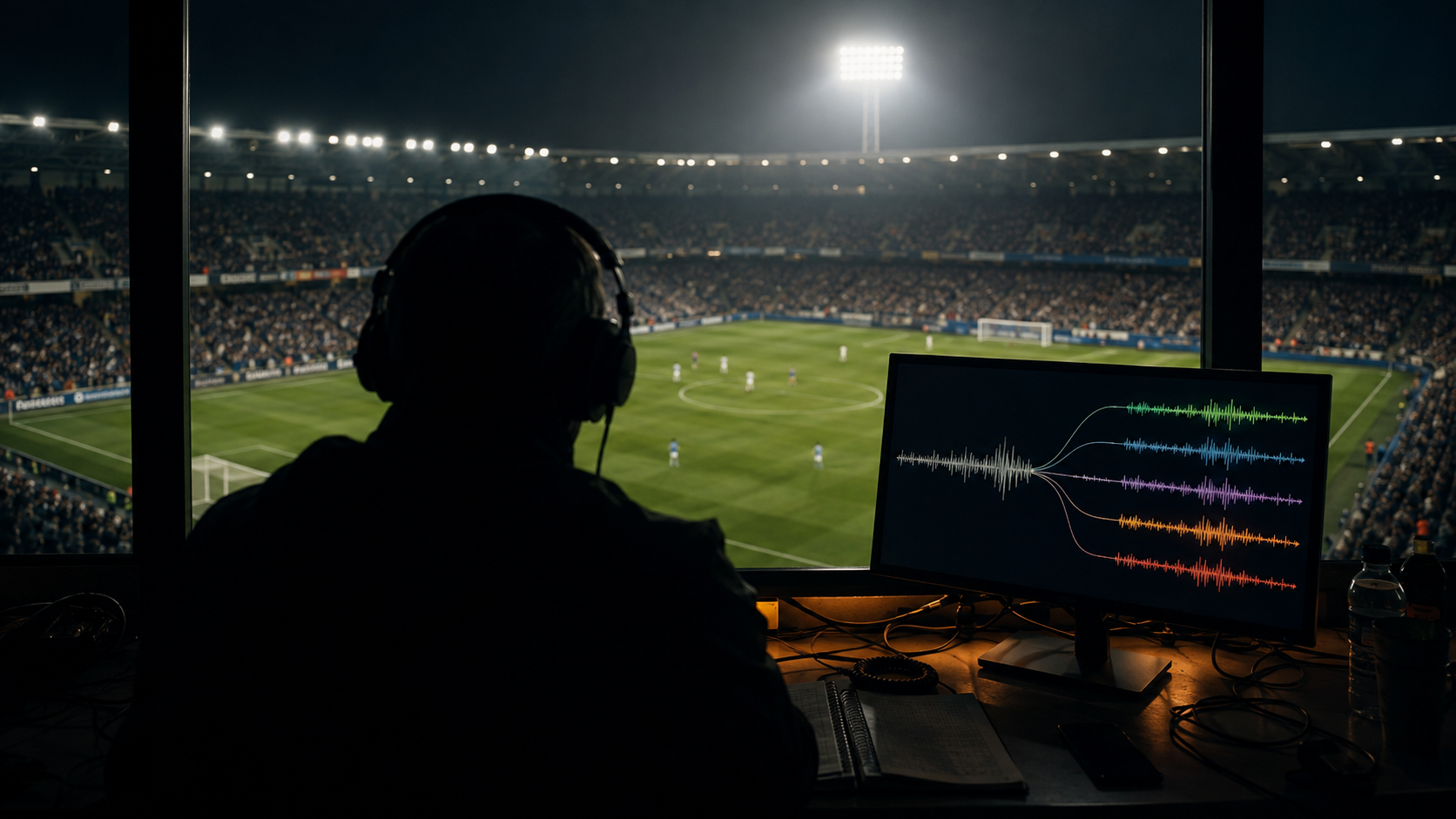
At the 2026 Trophée des Champions between Paris Saint-Germain and Marseille, Italian viewers on Ligue 1+ could select a commentary track that had never existed in the commentary gantry.
It looked as if a machine had stepped into the commentary box. It had not, at least not in the way most people would understand the phrase.
The system began with a French commentator calling the match in the usual way. AI then transcribed the human voice, translated the words and turned them back into Italian speech. The machine supplied the new language and voice. The human still supplied the timing, facts, excitement and judgement.
That distinction matters. LFP Media described the match as the first European football fixture with live AI-translated commentary. It also warned viewers that the quality and consistency could vary because the translation was automated. It was a real broadcast innovation, but it was a one-match translation trial, not a robot independently understanding PSG against Marseille.
Four different products are routinely squeezed into those two words.
One translates and dubs a human commentator. Another generates original descriptions from event data, tracking data or video. A third turns text into synthetic speech. A fourth assists the human production team by finding statistics, transcribing interviews, creating subtitles, extracting highlights or drafting scripts.
Confusing them makes the technology appear both more advanced and more threatening than it is.
The human hiding inside the machine
Live translation is the most convincing part of the market because it avoids the hardest problem. The AI does not need to understand the match. The source commentator has already done that.
MLS NEXT Pro demonstrated the model in April 2024 for Orlando City B against Inter Miami II. The normal English call was offered in French, Spanish and Portuguese, with CAMB.AI seeking to preserve the speaker's voice and tone. MLS used the technology again during its 2025 All-Star Week innovation showcase. That is more than a forgotten prototype, but it is still a series of trials rather than a published season-long service.
Ligue 1+'s French-to-Italian feed followed in January 2026. Outside football, Eurovision Sport offers the clearest sign that trials can become a recurring workflow. After testing translated commentary from 2024, it returned for the 2026 European Athletics Under-18 Championships. A French remote call was converted into eight languages, with every track labelled as AI-generated.
Korean baseball has gone further. A system involving Hudson AI, LG Uplus and Giad Sports dubbed Korean Baseball Organization coverage for international streaming channels during the 2025 regular season. It separated the Korean commentary from the stadium sound, translated it and rebuilt an alternate-language feed using localised baseball vocabulary.
These are meaningful deployments. They also expose what the live product presently is: human commentary with an automated international distribution layer.
The products can be bought. CAMB.AI markets live dubbing, AI-Media sells LEXI Voice, and Spalk offers AI translation alongside its remote-commentary services. What remains scarce is evidence of major football competitions using them, across multiple languages, for an entire season.
A ticker is not a commentator
Original generation is a different task. Here the machine must decide what happened, what matters and what to say about it.
AWS and Sportec Solutions built one of the better football examples using official Bundesliga data. Around 1,600 event-data points per match can feed a system that writes updates in different languages and selectable styles. Its average delay from action on the pitch to text on screen was reported as seven to 12 seconds.
That is useful automated commentary, but it is a live ticker. The public interface was a demonstration, and AWS explicitly described expressive audio as a future development. It is not evidence of a synthetic voice calling 90 minutes of Bundesliga football.
The Bundesliga also uses AI in a less theatrical but probably more valuable way. Its Data Story Finder searches the competition's enormous event and tracking datasets for patterns that commentators and producers may want to use. A person still decides whether a statistical prompt is interesting, relevant or best ignored. The system makes the commentary team better informed without pretending to be part of it.
The BBC's My Club Daily pilot sat somewhere else again. For four weeks in 2025, it turned existing BBC reporting about five football clubs into personalised two-minute audio bulletins. AI organised the material and generated the voice, but BBC journalists checked the scripts. It was automated football audio, not match commentary.
Even the 2026 World Cup did not settle the argument. Chinese rights-holder Migu promoted AI commentary with tactical analysis and regional dialects, without explaining whether play-by-play was generated, translated or layered around humans. Unofficial service FootyHub says it produced data-driven audio for all 104 matches. That shows what a small team can attempt, not what a rights-holder trusts on its main broadcast.
Why golf and tennis moved first
To see original generation at scale, look at sports that arrive in neat pieces.
The PGA Tour's TOURCAST uses trusted ShotLink data to generate written context for more than 30,000 shots during a tournament. The US Open has repeatedly used IBM technology to create English audio and subtitles for post-match highlights. The Masters used similar narration for thousands of shot clips in English and Spanish through 2025.
A golf shot has a start, an end and a detailed official record. A completed tennis highlight can be analysed before it is published. There is time to match the score, crowd reaction and clip, then produce a short line of narration.
Football refuses to be so polite. It is continuous, crowded and often ambiguous. A useful commentator must identify players, notice movement away from the ball, recognise a tactical change, know when not to speak and recover instantly when an apparent goal becomes an offside or a penalty disappears after VAR review. Event data can report that a shot occurred. It cannot, by itself, explain why the holding midfielder's movement created it.
A 2026 developer experiment that tried to build a live commentator from football video found the multimodal models tested were not sufficiently accurate or fast for the job. That was an engineering test, not a league procurement exercise, but its problems were revealing. A brilliant voice model is of limited use if the system speaking through it has misunderstood the picture.
The uneven record in tennis is instructive too. Wimbledon introduced AI narration for highlight videos in 2023 and dropped it the following year without giving a public explanation. A separate AI text feature then made basic factual errors in 2024. The two products should not be treated as the same failure, but together they underline a simple production rule: fluent output is not necessarily correct output.
The real opportunity is the empty commentary box
The strongest commercial case for AI is not replacing the voices on a Champions League final. It is adding a service where the budget never supported one.
That may mean an extra language, live audio for a youth match, coverage of every court or field event, narration for thousands of clips, or an accessible layer for supporters who cannot follow a ticker. At the Worcester Red Sox's Korean Night, English stadium commentary was translated into Korean and delivered to spectators' phones.
For a rights-holder, one source call could open several small language markets. For a lower-tier competition, competent synthetic coverage could be better than silence. Women's and youth competitions, which still receive uneven production investment, could gain inventory that would otherwise never be commissioned.
That proposition is plausible. Its economics remain frustratingly opaque.
Suppliers publish attractive latency and savings claims, but almost nobody publishes the full cost of a match. The bill can include the source feed, official data, audio separation, transcription, translation, speech generation, encoding, language quality control, monitoring, distribution and a human fallback when something breaks. A cheap voice model is not the same thing as a cheap broadcast.
Nor are the public latency figures directly comparable. The Bundesliga's seven-to-12 seconds measures a pitch event becoming text. AI-Media advertises roughly eight-to-12 seconds for live speech becoming translated speech. CAMB.AI has said its MLS deployment ran at under 30 seconds end to end. All are supplier or partner figures, and none provides a language-by-language audit of names, idiom, overlapping voices, sponsor messages or rapidly reversed decisions.
Delay can be hidden by holding back the video. Errors are harder to disguise. A pronunciation dictionary may fix a difficult surname. It cannot guarantee that a joke survives translation or that a synthetic voice strikes the right emotional note after a serious injury.
Whose voice is it anyway?
The technology also creates four assets where there used to be one: the source recording, the translated script, the synthetic audio track and, potentially, a reusable model of the commentator's voice. Ownership and permitted reuse depend on contracts that sports announcements rarely discuss.
There are better examples. Al Michaels agreed to the use of an AI recreation of his voice for Peacock's personalised Paris 2024 Olympic recaps after seeing a demonstration. NBC said editors reviewed every audio package and clip before publication. ESPN says the voices used for SportsCenter For You were developed in partnership with four of its presenters.
Spalk publishes the clearest talent proposition in live commentary. It says a commentator must opt in, can withdraw consent and may earn up to US$0.50 for every minute their voice model is on air. This is not an industry standard. It shows that reach, consent and recurring payment can be designed into the product.
Most public football trials disclose none of those terms. Did the original commentator approve every target language? Are they paid for one match or every translated feed? Can their voice be used on a fixture they did not call? Who is responsible when synthetic speech puts words into their mouth that they neither said nor understand?
This is where the tidy claim that AI either creates jobs or destroys them falls apart. Translation preserves the source commentator while potentially removing several target-language booths. Research tools assist human teams. Synthetic narration creates volumes of coverage that no broadcaster would staff manually, but it can also occupy work previously performed by commentators and voice artists.
Both effects are already happening. The balance will be decided less by the quality of the demo than by the contract behind it.
AI is therefore already in the commentary box, just rarely in the seat people imagine. Today it is most credible as a translator, a writer of structured updates, a synthetic reader and an assistant whispering statistics to humans.
Its first territory is unlikely to be the elite match with a beloved local pairing. It is the extra language, academy fixture, secondary stream, personalised recap and clip that previously had no voice.
That could make sport dramatically more accessible. It may also move the boundary of paid human commentary inward, one previously empty feed at a time. The technology is ready to fill silence. The sports business now has to decide whose voice, rights and work will fill it.
Sources
Source qualification: LFP Media's European-first characterisation is attributed in the article. CAMB.AI later described the Italian feed as having debuted, but no independently audited recording was available in the source file. Supplier latency, cost and capability claims remain expressly attributed throughout.
Primary and official evidence
- LFP Media, 2026 Trophée des Champions AI-dubbed commentary announcement, 5 January 2026. The publisher's first-European-football characterisation is attributed in the article. CAMB.AI's product page subsequently describes the Italian feed as having debuted at the fixture.
- MLS NEXT Pro, multilingual commentary test, April 2024, and MLS All-Star Week showcase, July 2025.
- EBU and European Athletics, multilingual AI commentary at the 2026 European Athletics Under-18 Championships, 9 July 2026.
- AWS and Sportec Solutions, Bundesliga AI live-commentary ticker architecture, July 2024.
- EBU case study on the BBC's My Club Daily pilot, 2025.
- PGA Tour, TOURCAST AI shot commentary, March 2025.
- IBM and USTA, US Open AI audio and subtitles, August 2025.
- IBM and the Masters, AI narration for shot highlights, April 2025.
- IBM, Wimbledon AI commentary launch, June 2023.
- NBCUniversal, Al Michaels personalised Olympic recaps, July 2024.
- Disney, ESPN SportsCenter For You, August 2025.
- AI-Media, WooSox Korean Night case study. Supplier case study. Its timing and impact claims remain attributed.
- Migu, 2026 World Cup AI experience release. Broadcaster marketing that does not specify the technical architecture of its claimed commentary.
- FootyHub. Self-reported World Cup service. Treated as an unverified independent claim, not as rights-holder adoption.
Supplier claims and independent reporting
- CAMB.AI's MLS case study, source for the supplier's under-30-second latency claim.
- AI-Media LEXI Voice, source for its product latency and pricing claims.
- Spalk AI Commentary, source for its opt-in, withdrawal and usage-payment model.
- Asia Business Daily on KBO, Hudson AI, LG Uplus and Giad Sports, April 2025.
- The Guardian on Wimbledon's withdrawn AI commentary and subsequent text errors, July 2024.
- Stream's football-video commentator build, 2026. A technical experiment, not a league deployment.